The incorporation of nanoparticles into polymers to develop advanced nanocomposite membranes was found to significantly enhance properties such as thermal stability, mechanical strength, permeation, and electrical conductivity. Making nano-sized materials and keeping them nano are the major challenges to induce the desired functionality of these materials to the common polymeric membranes.
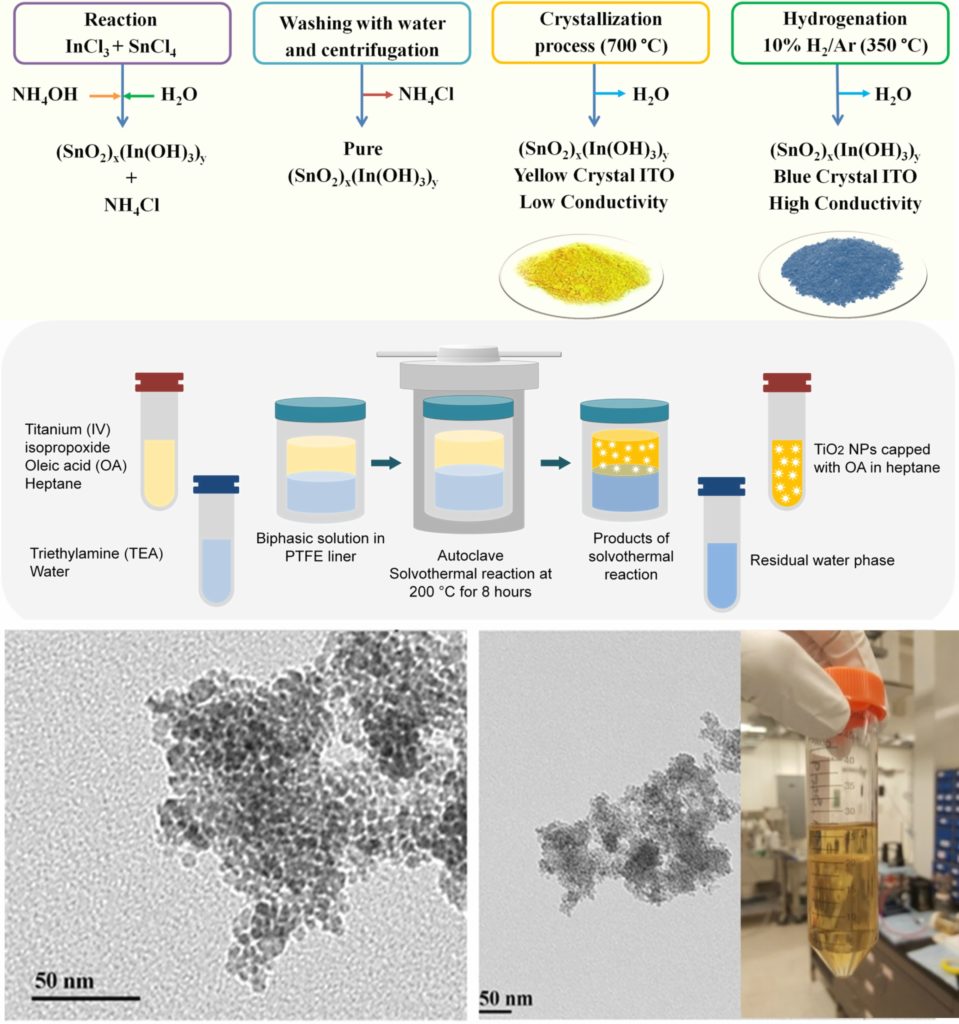
The proper synthesis of nanoparticles requires a deep understanding of the size and shape of the nanoparticles, as well as the kinetics and thermodynamics of the synthesis reaction. In the AWRL we are able to synthesize TiO2, ITO, and ATO nanoparticles. TiO2 NPs are synthesized using well-known biphasic solvothermal reaction where hydrolysis and nucleation occur at the interface of the organic phase (containing a TiO2 precursor and a dispersing agent) and water phase, resulting in the nucleation of the dispersing agent-capped TiO2 NPs. For the synthesis of ITO and ATO NPs, according to the liquid phase co-precipitation method, their corresponding metal chloride precursors react in the presence of ammonium hydroxide. The product then is crystallized into yellow crystals and hydrogenated to produce blue, conductive crystals.
AWRL is actively collaborating with Dr. Karthik Shankar (Dept. of Electrical Engineering, UofA) and Dr. Pu Chen (Dept. of Chemical Engineering, UWaterloo) to synthesize TiO2 nanowires and nanotubes, and various derivatives of graphene oxide (GO), respectively. The successful application of NPs strongly depends upon the surface modification approaches. For each type of nanomaterial and solvent surface, functionalization strategies must be developed that rely on the balance of intermolecular forces between nanomaterials including attractive forces (e.g. covalent and hydrogen bonding, electrostatic attraction between oppositely charged ligands, and dipole–dipole interactions) and repulsive forces (e.g. steric forces and electrostatic repulsion between ligands of similar charge).